All Publications

Papers, essays, analytical briefs, memoranda and speeches. Every publication is free to download.
Filter

Type

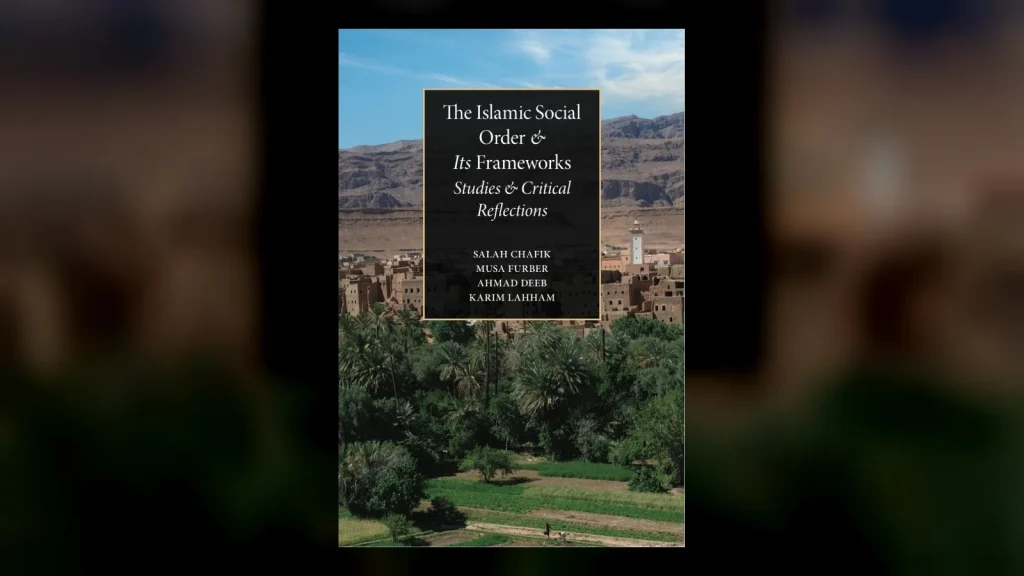
Cover of The Islamic Social Order and Its Frameworks: Studies and Critical Reflections

2025Special Publications

By Salah Chafik, Musa Furber, Ahmad Deeb, Karim Lahham

This book aims to both rediscover and advance practical notions of commonweal, or common good, retrieval in an Islamic social order. The first chapter explores shuʿab al-īmān or “branches of faith,” a holistic system of values and actions derived from various sound hadiths, though largely overlooked today. Musa Furber analyses classical texts and classification schemes of the shuʿab to demonstrate how these timeless branches can serve as a guide for spiritual refinement, ethical conduct, and social cohesion. In the second chapter, Ahmad Deeb traces how the metaphysical rupture caused by modernity fosters loneliness and erodes traditional structures of belonging, then proposes a philosophy of community attuned to, and able to nurture, the psychological well-being and cohesion that are an innate human need. The third chapter maps out a skill-based social order animated by Islamic principles: Karim Lahham illustrates how, through intention, work becomes a communal obligation, serving both material needs and spiritual fulfilment, and steering the ethos of such a society towards virtuous praxis whilst transcending the self.
The Anatomy of Knowledge & the Ontological Necessity of First Principles

2021Special Publications

By Karim Lahham

This paper in the series explores one of the first principles of metaphysics, the principle of identity in its logical form, namely, the principle of non- contradiction, and the relationship between its metaphysical and logical dimensions. It is invariably the task of revelation to provide definable and recognizable references that can be brought into human understanding. Logic is given the role of providing in us an eternal order reflective of the order of creation, a role that bestows upon it, therefore, a certain sacrality. The Kantian conceptualist contention, now often encountered, establishes the basis for the contemporary de-ontologization of logic, since it creates a split between second intentions and first intentions, ensuring that reality has no input into the workings of the mind. Secondary intelligibles, however, are based on first intelligibles – things that exist – and thus they are ontologically dependent and reflective of that order. The logical thus can never contradict the metaphysical, and the metaphysical can never in turn be illogical. This seamlessness between the two orders is critical to the safeguarding of a sound intellectual discourse enabling the human soul to understand its existential condition, a condition that remains the same regardless of time and place.
Things as They Are: Nafs el-Amr & The Metaphysical Foundations of Objective Truth

2021Special Publications

By Hasan Spiker

In a philosophical idiom that attempts to be intelligible to the reader who is not traditionally trained, this study outlines various dimensions of traditional Islamic ‘correspondence’ theories of truth. It particularly argues that purely intelligible, ‘abstract’ concepts, universal natures and general principles objectively apply to the world, against schools of thought that contend that they are subjectively imposed. It is only by discerning the congruity or discordance of these fundamental instruments of general metaphysics with forms of extramental reality, that we are able to avoid the implication that their lack of sensible referents implies our knowledge of the world – which is contingent upon the employment of these instruments – must be ultimately subjective. These intelligible entities, universal natures and general principles can thus only be validated by situating them within an all-encompassing theory of objective reality and truth, in the Islamic tradition nafs al-amr or ‘things as they are’. Transcending individual minds and sensible reality, such a theory must be sufficiently broad to account for the ultimate ontological and henological status of such universal and abstract principles and forms. This study demonstrates that a synthetical approach to the nature of objective reality and truth, drawing on the Avicennan and kalām, and especially Platonic and Akbarian traditions, is capable of effectively responding to subjectivist, anti-metaphysical views on the nature of the world and our knowledge of it. It purports to do this in a manner that strengthens the deepest foundations underlying traditional natural theology, illustrating that the physical world of particulars is ‘intelligible’ (in the sense of ‘objectively knowable’) exactly because it is a branch of an ‘intelligible’ (as the contrary of ‘sensible’), non-physically instantiated world.
Muslim Usage of the Internet

2017Analytical Briefs

By Musa Furber

This study explores how Muslims use the Internet for religious purposes and whether usage patterns vary between Muslim minority and Muslim majority states.
Beauty and the Sacred Law

2017Essays

By Musa Furber

It is for the purpose of securing all that is beautiful that God revealed the Sacred law. Any attempt to modify or implement it in a piecemeal fashion only distorts it, leading to ugliness rather than beauty.
Being ‘Good’: An Ontological View of Ethics

2017Essays

By Karim Lahham

This paper frames ‘ethics’ as a science of the soul. By focusing on the role of an integral metaphysics within the ambit of the classification of sciences, it seeks to both determine the parameters of ethics and also underline the relationship between modes of being and modes of action.
Intensive Animal Farming: Wrongs & Responsibilities

2017Essays

By Musa Furber

This essay addresses the welfare of animals farmed industrially for consumer markets, from the perspective of the Sacred Law.
The Public Understanding of Islamic Scholarship in Society

2016Analytical Briefs

By Musa Furber

In this piece, Musa Furber offers a hypothesis to express reasons of faux fatwa “fiqhtion addiction”, and propose activities to address the problem.
Gandhi, Islam, and the Principles of Non-violence and Attachment to Truth

2015Speeches

By Karim Lahham

Lecture given by Dr. Karim Lahham at the Cambridge Muslim College, Cambridge, England, on March 2015.
Rights and Duties Pertaining to Kept Animals

2015Papers

By Musa Furber

A case study in Islamic Law and Ethics by Musa Furber. Animals are at the heart of many of today’s heated ethical and legal debates. This paper presents a survey of Qur’anic verses and prophetic narrations related to kept animals, and a study of one school’s application of this evidence to the topic of kept animals. This ethical and legal study will also throw into relief some of the mechanism of madhhab based jurisprudence and fiqh reasoning. This study serves as a basis for understanding and applying Islamic moral theology to the numerous contemporary issues related to kept animals.
The Exercise of the Islamic Juristic Reasoning by Ascertaining the Ratio Legis

2015Papers

By Abdallah Bin Bayyah

Addressing a number of major moral and legal questions of our age, Shaykh Bin Bayyah describes how Muslim jurisprudence works to alleviate human hardship and to account for cases of compelling necessity while remaining true to the moral vision of God’s final Shari‘ah.
Metaphysics & Sociology

2014Speeches

By Karim Lahham

A lecture addressing the myth of metaphysical neutrality in sociology and some of the rationale behind the dismissal of metaphysical categories in the social sciences. The piece concludes by asserting some normative elements of the Islamic social order and their raison d’être and how they reflect the unity of the Islamic sciences.
Craftsman carving traditional Islamic plasterwork above a zellige tile panel

2013Speeches

By Karim Lahham

A speech addressing the social philosophies and institutions, many of them common to Muslims and Christians, comprising a vocational and godly society.
Elements of a Fatwa & Their Contribution to Confidence in Its Validity

2013Analytical Briefs

By Musa Furber

This exploratory study examines the confidence Sunni Muslims place in the validity of fatwas based on their elements. It recommends that institutes which issue or disseminate fatwasdisseminate fatwas ensure that their muftis are known to the public they serve.
Metaphysical Dimensions of Muslim Environmental Consciousness

2013Essays

By Jihad Brown

Much of the contemporary Muslim discourse surrounding the environment takes place at the level of ethical duty—juristic commands and prohibitions. The present essay seeks to complement and underpin this necessary ethical discourse by offering considerations as to the metaphysical dimensions of a Muslim environmental consciousness. Through a beautiful and lucid engagement with the Qur’an, the Prophetic sunnah, and the insights of some of Islam’s greatest mystical poets, a vista unfolds in which the natural order is perceived as a locus of the theophany of the divine names. In light of this connection, the Shari‘ah’s teachings as to man’s relationship with creation as steward (khalīfah) may be both better understood and experienced.
Ranking Confidence in the Validity of Contemporary Fatwas & their Dissemination Channels

2013Analytical Briefs

By Musa Furber

The present exploratory study examines the confidence Sunni Muslims place in the validity of contemporary fatwas communicated through a variety of communication scenarios. It recommends that newspapers and others reporting on fatwas change their focus in the types of legal opinions they choose to communicate.
Response to Cardinal Scola’s House of Lords Speech

2013Speeches

By Karim Lahham

This text published today serves as a response to Cardinal Angelo Scola in his speech at the House of Lords, by offering his frank reflections on the presence of Muslims in Europe. This was addressed positively as a factor that contributed to the construction of a ‘good life’ for all communities, on the one hand, whilst on the other, stated negatively that the mere presence of Muslims in Europe constituted a potentially inassimilable problem and a challenge to the status quo.
The Intelligibility of the Islamic Tradition in the Context of Modern Thought

2013Speeches

By Karim Lahham

A speech addressing the social philosophies and institutions, many of them common to Muslims and Christians, comprising a vocational and godly society.
The Problem of Reductionism in Philosophy of Mind and its Implications for Theism and the Principle of Soul

2013Papers

By Jihad Brown

This essay seeks to delineate points of entry for Muslim theological reasoning into conversations in the field of philosophy of mind. By equating the Kalam principle of soul with its foremost faculty, intellection, Muslim theological reasoning lends itself well to these modes of inquiry. By looking at the work of Saul Kripke and Hilary Putnam, the collapse of “reductionism” is shown to give way to the concept of a non-physical mind, as well as an indication toward the sustainable plausibility of theism in general. The essay demonstrates that contemporary obstacles and challenges to the theological principle of a human soul are surmountable,and adds to mounting scholarship in the field that calls into question the physicalist interpretation of the universe.
Living Islam with Purpose

2012Papers

By Umar Faruq Abd-Allah

This paper offers an operational framework for establishing an authentic expression of indigenous Muslim culture. This framework consists of five operational principles, which are discussed at length and illustrated with examples: trusting reason, respecting dissent, stressing societal obligations, setting priorities, and embracing maxims. These five principles are central to the Islamic tradition and embody the practical wisdom and consummate sensibility of the Prophetic teaching. The paper emphasizes the need for Muslim communities as a whole to become directly involved in their self-definition and the construction of their future as individuals and communities. This task cannot be left to others or to chance; the five operational principles provide an invaluable resource for determining the way forward. While the paper focuses on the American Muslim community, the framework is relevant to Muslims everywhere, especially those in the West.
Muhammad Shahrur’s “Cargo Cult”: A meditation on his underlying conceptual framework

2012Papers

By Karim Lahham

The purpose of this paper is to present an integral critique that explores the underlying conceptual structure of the work of Muhammad Shahrur. It is the author’s contention that every thinker and writer is an inheritor of a chain of ideas or an intellectual system that he necessarily manifests in his writings, consciously or unconsciously. There is no such thing, in other words, as an orphan idea or an idea without a conceptual genealogy. This means that the integrity or soundness of any idea is narrowly dependent on the pedigree of its genealogy or silsila. The value of Shahrur’s thought is therefore inevitably linked to the value of the origin of his ideas, which we have briefly attempted to trace and evaluate in this paper. It is hoped that this model of critique may become an effective tool in understanding the mechanics of the varying and hybridised conceptual systems that ‘reformers’, or one should say ‘intellectual adventurers’, have recently introduced into the Islamic world.
Obligations to Future Generations: A Shari‘ah Perspective

2012Papers

By Musa Furber

Actions of an earlier generation affect whether later generations will exist at all as well as the quality and type of life they will have. Discussions concerning the obligations earlier generations owe later generations have proven to be useful when thinking about the environment, economics, sustainability, and other issues. Western thinking about obligations to future generations has become very sophisticated since the 1970s. Western ethicists consider it a litmus test for evaluating ethical theories, and expect it to be a main recurring theme in the new century. The Shari’ah already provides the fundamentals for thinking about obligations to future generations. These basic fundamentals are not developed enough to shed light on these issues within the Muslim Community, let alone compete in the open market of ideas. Shari‘ah experts will need to develop these fundamentals before a Shari‘ah-informed conception of obligations to future generations can be offered.
Reducing The Role of Decision-Making Biases in Muslim Responsa

2012Analytical Briefs

By Musa Furber

The role of decision-making biases in the fatwa process. Muslims often consult a legal expert (a mufti) concerning legal issues and to mediate intra-personal situations. A consultation with a mufti follows a process which includes conception, adaption, evaluation, and, finally, the response. While reviewing fatwas for errors, the author observed that many of the errors encountered could be explained as errors resulting from rules of thumb employed to facilitate information processing and decision making – that is: decision biases resulting from employing heuristics. This brief introduces the fatwa process, as well as decision-making heuristics and biases. It then presents an analysis of how biases come into play during the fatwa-delivery process. It concludes that there is a need to better understand decision-making heuristics and biases, and the negative impact of relying upon heuristics in Islamic disciplines. It also recommends that muftis be informed of decision-making biases, and that mufti training programs include decision-making biases in their curriculum so as to improve the quality of the services they provide. It is hoped that examining these errors in this way might help reduce future errors and improve the impact that fatwas have on petitioners’ lives.
Alternative Dispute Resolution: Arbitration & Mediation in non-Muslim Regions Alternative Dispute Resolution: Arbitration & Mediation in non-Muslim Regions

2011Analytical Briefs

By Musa Furber

Shari‘ah-based personal dispute resolution for Muslims living in non-Muslim regions. Dispute resolution remains a difficult issue for Muslims living in non-Muslim regions. While Muslims within Muslim regions do usually have access to Shari‘ah-based personal dispute resolution through settlement in court by an appointed judge (qāḍī) whose judgments are binding and enforceable, the absence of such judges in non-Muslim regions leaves Muslims residing in such lands without this option. The problem is augmented by the widespread belief that an Islamic state’s courts are the only acceptable means by which to obtain binding dispute resolution for Muslim litigants. The current state of affairs is particularly harmful to Muslim wives in abusive marriages, since it leaves them no means within the Shari‘ah to rectify their situation. This Analytic Brief will show that the classical schools of Islamic Law provide other options relevant to the current situation. The first part of this Brief will introduce the various models for personal dispute resolution which are covered in classical Islamic law. The second part of this Brief will then discuss the applicability of each model and present a possible strategy for their application in a manner that respects and is harmonious with both the Shari‘ah and the legal environment of Muslims living in non-Muslim regions. The Brief will close by demonstrating how these models might be applied to the problem of Muslim wives caught in abusive marriages.
Beyond Flak Attack: A New Engagement with the Newsroom

2010Essays

By Nazim Baksh

This essay is written for Muslim activists and scholars who are alarmed at today’s headlines and would like to engage the mass media in the hope of balancing its predominantly negative reporting with positive stories pertaining to Islam and Muslims.
Islam-West Dialogue: A Critical Analysis of the Davos Report

2010Analytical Briefs

By Irfana Hashmi

A summary and critical analysis of the document Islam and the West: Annual Report on the State of Dialogue, January 2008, its core issues and recommendations for Muslim leaders and scholars of Islamic Sacred Law (Shari‘ah). The 2008 Islam and the West report, commissioned by the World Economic Forum and Georgetown University, is a global reference on the state of the Muslim-West dialogue for leaders across multiple sectors, including government, media, education, civil society, and faith communities. Overall, it highlights the activities of approximately 90 organizations and describes more than 80 events around five issue areas: International Politics; Citizenship and Integration; Religion, Ethics, and Ideology; Education and Intercultural Understanding; and Economic and Social Development. It also draws on the Gallup Muslim-West Dialogue Index and media content analysis carried out by Media Tenor International to discuss public perceptions of the dialogue and the tone of media coverage both in Muslim and non-Muslim countries. Very few perspectives from within the community of scholars of Shari‘ah are offered in the report. This brief introduces the report, discusses its main findings, and offers suggestions on how Muslim scholars and opinion leaders can contribute to the dialogue in a meaningful way. This report is an opportunity for Muslim scholars to build on the discussion already in progress, share best practices on how to further promote dialogue, and become better equipped to answer the needs of diverse Muslim communities.
Language Matters: A Dialogue on Language and Logic

2010Essays

By Taha Abdurrahman

The essay that follows seeks to illuminate new perspectives and insights on linguistics and language-related topics as a significant component of the intellectual project of Dr Taha Abderrahman. As one of the most eminent contemporary Muslim thinkers, selected questions raised by some of his foremost students and colleagues allow the author to dwell and expand on issues relating to logic and philosophy, touching briefly on matters of politics, religion, and theology.
Islamic Discourse: Between the Conclusive and the Variable [Sh. Abdullah Bin Bayyah]

2009Papers

By Abdallah Bin Bayyah

Perhaps the most looming challenge before Islam today is to be understood. Mis-representation on the part of international media punditry does contribute much to this dilemma, as well as general myopia within the consciousness of Western publics regarding their own “others”; a category within which Islam, more often than not, features as the primary candidate.
Ethics & Virtual Worlds: Second Life as a Case Study

2009Analytical Briefs

By Musa Furber

An introduction to Linden Lab’s Second Life and virtual worlds, the ethics of virtual worlds, and an outline of related issues in need of informed Shari‘ah reflection. Linden Lab’s Second Life is one of the many interactive virtual worlds where people spend a great deal of time and money. Virtual worlds include online metaverses, online computer games, and video games (e.g. Second Life, Blizzard Entertainment’s World of Warcraft, and Rockstar Games’ Grand Theft Auto). Participants in these increasingly-realistic life-like virtual universes engage in activities ranging from simple conversations and financial transactions, to simulated sex, violence, and rape, or even marriage and divorce. There is a real need to examine the legal status and ethical standing of interactions within these virtual worlds. The first section of this Analytic Brief introduces Second Life and its applications, followed by a summary of criticisms and concerns that have already been raised. The second section gives a summary of how ethicists have analyzed virtual behavior in the context of computer games and virtual worlds. The third section of this Brief presents issues related to virtual worlds which are in need of informed Shari‘ah reflection from scholars and opinion leaders, and shows how classic Islamic legal reasoning already provides answers to many of the relevant issues.
How We Got Here: A Critical Analysis of Niall Ferguson’s “The Ascent of Money”

2009Analytical Briefs

By Haroon Moghul

Niall Ferguson’s “The Ascent of Money: A Financial History of the World” offers a history of six crucial components to modern capitalism, the benefits these provide, and the consequences of their realization. This review of Niall Ferguson’s The Ascent of Money: A Financial History of the World is divided into three sections. After introducing Ferguson, I summarize the themes and content of this conceptual history of modern finance, noting those arguments most relevant to a scholarly Islamic audience. In closing, I will attempt the following: Firstly, to discuss the intellectual climate that reflects Ferguson’s positions, those beliefs and values which frame his book. Secondly, to point out the relevance of conceptual histories to Islamic scholarship, taking Ferguson’s work as an inspiration to begin similar projects, albeit within and for the Islamic tradition. Lastly, to explain how conceptual histories of Islamic finance will provide depth to Islamic scholarship, on questions of finance, economics and the like. I will end with a series of questions designed to stimulate further discussion.
Intellectual Formation as a Conduit to the Spiritual Dimension of Man

2009Memoranda

By Tabah Research

The purpose of this Tabah Research seminar held at St Cross College, Oxford, was to explore the relationship between spiritual knowledge and the philosophical sciences by way of Dr Taha Abderrahmane’s experiences in both disciplines. In his understanding the philosophical quest and its attendant activities are proposed as essentially a force for inter-cultural and cognitive unity.
Ethical Dimensions of Nanotechnology

2008Analytical Briefs

By Musa Furber

This brief paper introduces the subject of Nanotechnology and its ethical implications as an applied technology. It goes on to explore and present a blueprint for the theological, legal and ethical issues which Muslim scholars may need to address, as well as a framework through which scholars can determine relevant solutions. Nanotechnology comprises several fields where matter is viewed and manipulated at the extremely small scale of billionths of a meter. At this scale matter exhibits phenomena and properties that can be used for new applications. Nanotechnology has already made its way into common consumer products such as stain-free cloth, sunscreen, and computer chips. Unfortunately, nothing conclusive is known about the additional health and environmental risks of matter at such a small scale. Concern about these risks, and about how nanotechnology will be used and its impact on society have prompted several invitations for public discussions on the ethical dimensions of nanotechnology. Religious perspectives have been requested. Muslim scholars and opinion leaders have yet to respond. This brief introduces the topic of nanotechnology and its ethical dimensions. It then presents a blueprint of the theological, legal, and ethical issues which Muslim scholars and opinion leaders may need to address, as well as a framework through which scholars can begin working out some of the answers.
A Comparative Analysis of the Common Word Dialogues

2008Memoranda

By Tabah Research

A concise review and analysis of the Common Word initiative, its history, and the response of the Archbishop of Canterbury, the Reverend Rowan Williams. A Common Word between Us and You is the letter that began an interfaith initiative led by key Muslim institutions and endorsed by prominent Muslim scholars. The focus of the initiative is to identify common ground between Muslims and People of the Book (specifically Christians), and using this common ground to achieve peace and work towards their shared interests and future. The proposal has been welcomed by the Christian community and it has already triggered tangible results. Key among them is the response of the Archbishop of Canterbury in a letter entitled A Common Word for the Common Good. The initiative’s website address is http://www.acommonword.com.
The Roman Catholic Church’s position on Islam after Vatican II

2008Papers

By Karim Lahham

A study and analysis of the philosophy underlying the Catholic Church’s approach to dialogue with non-Catholics and non-Christians. The study includes a presentation of the official Church position on Islam and Muslims following the SecondVatican Council.
A Global Ethic: Its Scope and Limits

2008Papers

By Taha Abdurrahman

Taha Abderrahman, the author, holds that a critical window of opportunity remains open for theistic world views to collectively provide a program of shared ethics. However, it is his assertion that recent attempts to furnish a set of fundamental criteria, in the name of world religions, have failed to deliver on the promise. Drawing on the richness of Islamic theological systems, the author endeavors to provide both a critical analysis and a corrective prescription.
The Lost Tools of Learning: Text and Analysis

2008Analytical Briefs

By Tabah Research

The “Lost Tools of Learning” is a study and analysis of classic educational systems in the West with an introduction outlining their respective implications for Islam.
Reasonable Accommodation

2008Analytical Briefs

By Nazim Baksh

“Reasonable Accommodation” contends that religious practices will no longer be sheltered under the umbrella of multiculturalism. Further, it imposes a limitation on the participation of faith in the public space by stipulating a condition of “reasonable proof” on religion.
Recommendations to Support the Moderate Trends Among Muslim Communities

2007Analytical Briefs

By Tabah Research

The RAND report entitled “Building Moderate Muslim Networks” is a follow- on from the two previous RAND reports entitled “Civil Democratic Islam” and “The Muslim World after 9/11”, and focuses on identifying partners and developing a strategy for working with the latter. This brief contribution is a summary and analysis of the conclusions of that report.
Here Today, Gone Tomorrow

2007Analytical Briefs

By Tabah Research

“Here Today, Gone Tomorrow” is an analytical reading of the conclusion of a survey including 16 scientists and thinkers. It was conducted by “Foreign Policy” and covered the main scientific, social and political phenomena which are present today, yet predicted to disappear within 35 years.